This is the question a lot of Indian professionals in the US eventually ask, and it is hard to answer in a spreadsheet because the two lives have different costs, different inflation, a currency between them, and the same portfolio. Here is one couple's version of it, built in Bhavitta with the app's defaults and its own city estimates, with every number the engine produced. Change any input and the answer changes; that is the point of the app, and the reason this page ends with a download link rather than a conclusion.
The couple and the two plans
- Both 40, planning to 90. Household of two.
- $900,000 invested today, all treated as one portfolio.
- $250,000 household income in Seattle, a 32% blended tax rate while working.
- Comfortable lifestyle. Bhavitta's Seattle estimate at that tier is $142,500 a year for two in today's money; its Bangalore estimate is $59,500.
- $30,000 a year of Social Security from 67, indexed, in both plans.
- Defaults everywhere else: 7% expected return and 12% volatility for Monte Carlo, 3% US inflation, 6% India inflation, 3% a year rupee depreciation, constant-real spending, 80% survival benchmark on the bad-markets (P80) line.
| Plan A — Stay in Seattle | Plan B — Move to Bangalore at 50 | |
|---|---|---|
| Ages 40 to 49 | Seattle, working | Seattle, working |
| Ages 50 to 64 | Seattle, working | Bangalore, no earned income |
| Ages 65 to 90 | Seattle, retired | Bangalore, retired |
| Planned retirement age | 65 | 50 |
What the readiness card says
Historical replay, the app's default, runs each plan through all 47 fifty-year windows of S&P 500 history since 1928.
| Stay in Seattle | Move to Bangalore at 50 | |
|---|---|---|
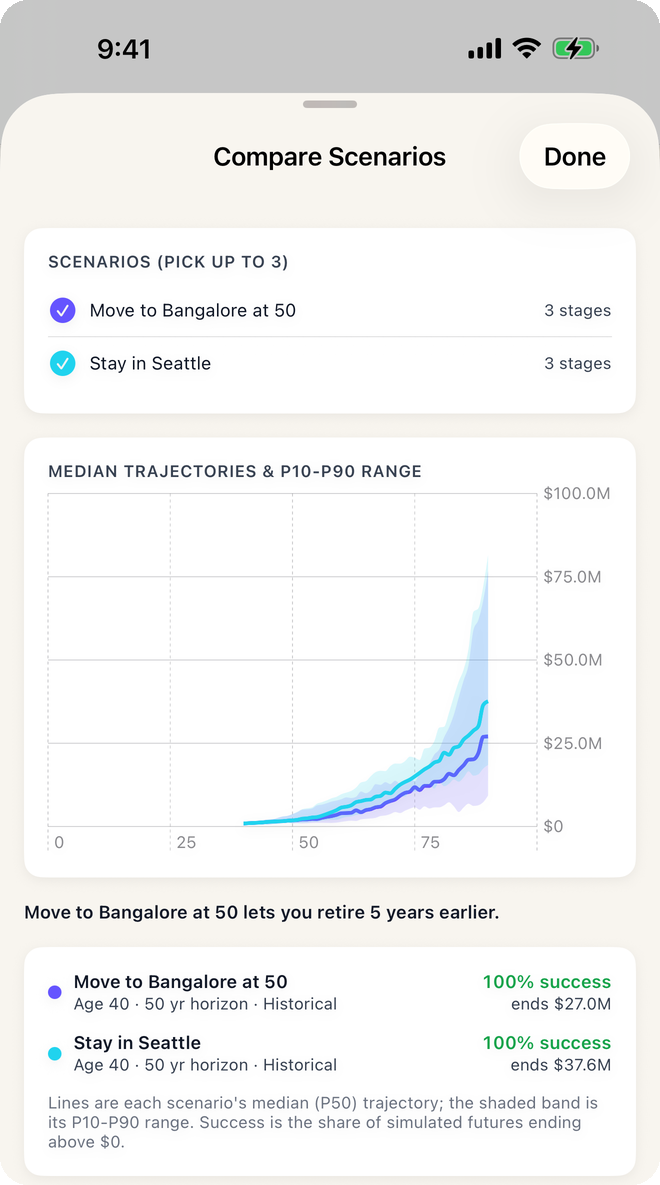
| Survival at the planned retirement age | 100% | 100% |
| Readiness score | 100 | 100 |
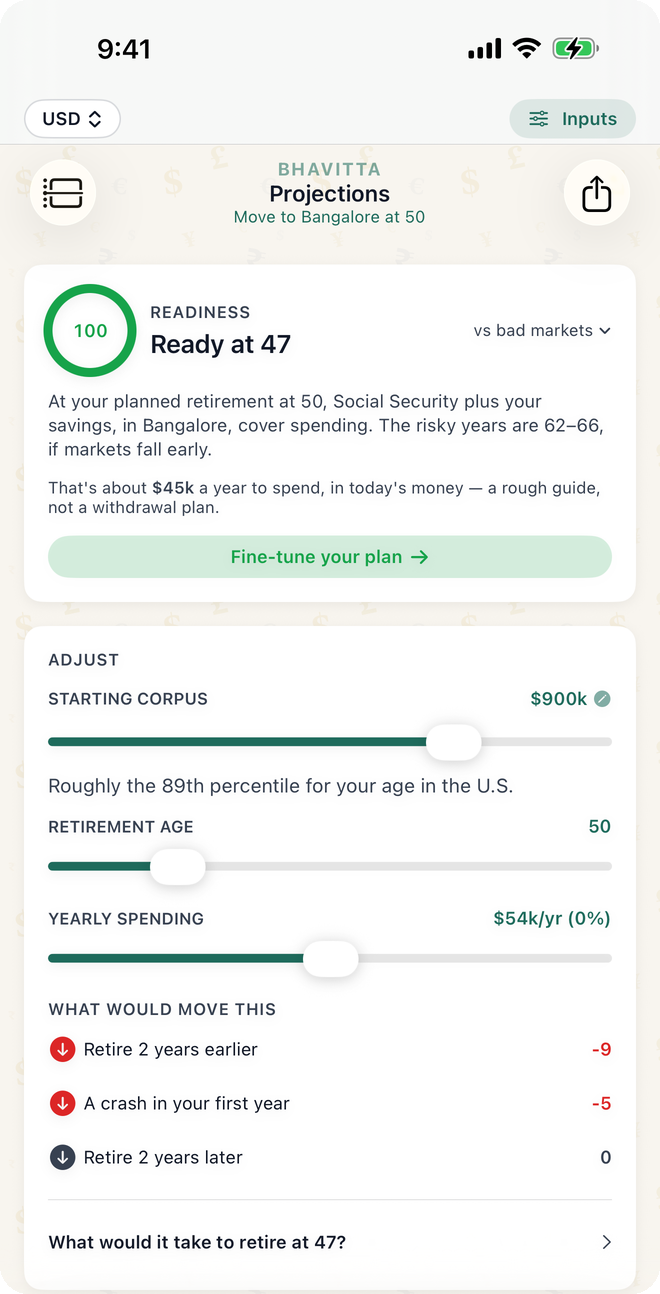
| Headline | Ready at 52 | Ready at 47 |
| Earliest age clearing the 80% bar | 52 (81%) | 47 (91%) |
| First-year retirement spending, today's $ | $142,500 | $59,500 |
| Typical (P50) balance at 80, today's $ | $19.7M | $13.5M |
| Bad-markets (P80) balance at 80, today's $ | $14.6M | $9.5M |
Both plans as written are comfortably safe; a couple earning $250,000 and working to 65 with $900,000 already saved does not have a survival problem. The interesting line is the headline. The solver asks "what is the earliest age at which earned income can stop and the plan still clears 80%?" and gets 52 in Seattle and 47 in Bangalore. The app's own explanation for Plan B reads: "At your planned retirement at 50, Social Security plus your savings, in Bangalore, cover spending. The risky years are 62–66, if markets fall early."
The same question, year by year
Instead of one solved age, here is survival for each candidate stop-working age. The historical column is the default model; the Monte Carlo column is the deliberately conservative one, 7% expected return against history's roughly 9.8%.
| Stop working at | Seattle, historical | Seattle, Monte Carlo | Bangalore, historical | Bangalore, Monte Carlo |
|---|---|---|---|---|
| 45 | 23% | 0% | 70% | 20% |
| 48 | 43% | 2% | 94% | 58% |
| 50 | 62% | 7% | 100% | 80% |
| 52 | 81% | 11% | 100% | 80% |
| 55 | 94% | 24% | 100% | 80% |
| 58 | 100% | 40% | 100% | 80% |
| 60 | 100% | 53% | 100% | 80% |
| 62 | 100% | 63% | 100% | 80% |
| 65 | 100% | 76% | 100% | 80% |
In Plan B the move itself ends earned income at 50, so "stop working at 55" is the same plan as "stop at 50"; the Bangalore columns flatten from 50 onward. Monte Carlo figures below the solver rows used 2,000 trials per cell; the headline rows used 10,000.
How to read it
- Spending is the lever, not returns. Dropping the retirement budget from $142,500 to $59,500 a year moves the earliest safe stop-working age from 52 to 47 on history, and from "work to 65 and still land at 76%" to "stop at 50 at 80%" on the conservative model. No return assumption in the app does that much.
- The models disagree on how safe, not on which plan wins. History says both plans are fine from the mid-fifties; Monte Carlo at 7% says Seattle needs work past 65. Which one you believe is a view about future US equity returns, and the app lets you hold either.
- Rupee depreciation is doing quiet work. Bangalore costs rise at 6% in rupees but about 2.9% in dollars under the default 3% depreciation. Set depreciation to 0% and Bangalore inflates at 6% in dollars, and the gap between the plans narrows; set it higher and it widens. Worth a slider pass.
- Neither plan is a recommendation. The example leaves out Indian income tax on the portfolio's gains after the move, NRI-to-resident tax status, health insurance in either country, property, children, and the parents everyone in this situation is actually planning around. Each of those is a stage or an overlay you add.
Build it yourself in five minutes
- On the Start tab, answer the guided questions with your age, savings, income and city, or begin from the ready-made "Retire early" life story.
- On My Plan, make sure your working-years stage ends at the age you would move. Add a second location stage for Bangalore, or any of the 49 cities, from that age to the end, with zero income.
- Add a Social Security or pension overlay with your own estimate and start age.
- On Scenarios, duplicate the plan, and in the copy change the move age or remove the move entirely.
- Select both and tap Compare. The winner line tells you which plan retires earlier, and the overlay shows both fans together. Then try the "Move abroad" and "Market crash" chips on either plan.
Run it with your own numbers
Free on iPhone and Android. No account; your plan never leaves your phone.
Download on the App Store Get it on Google Play